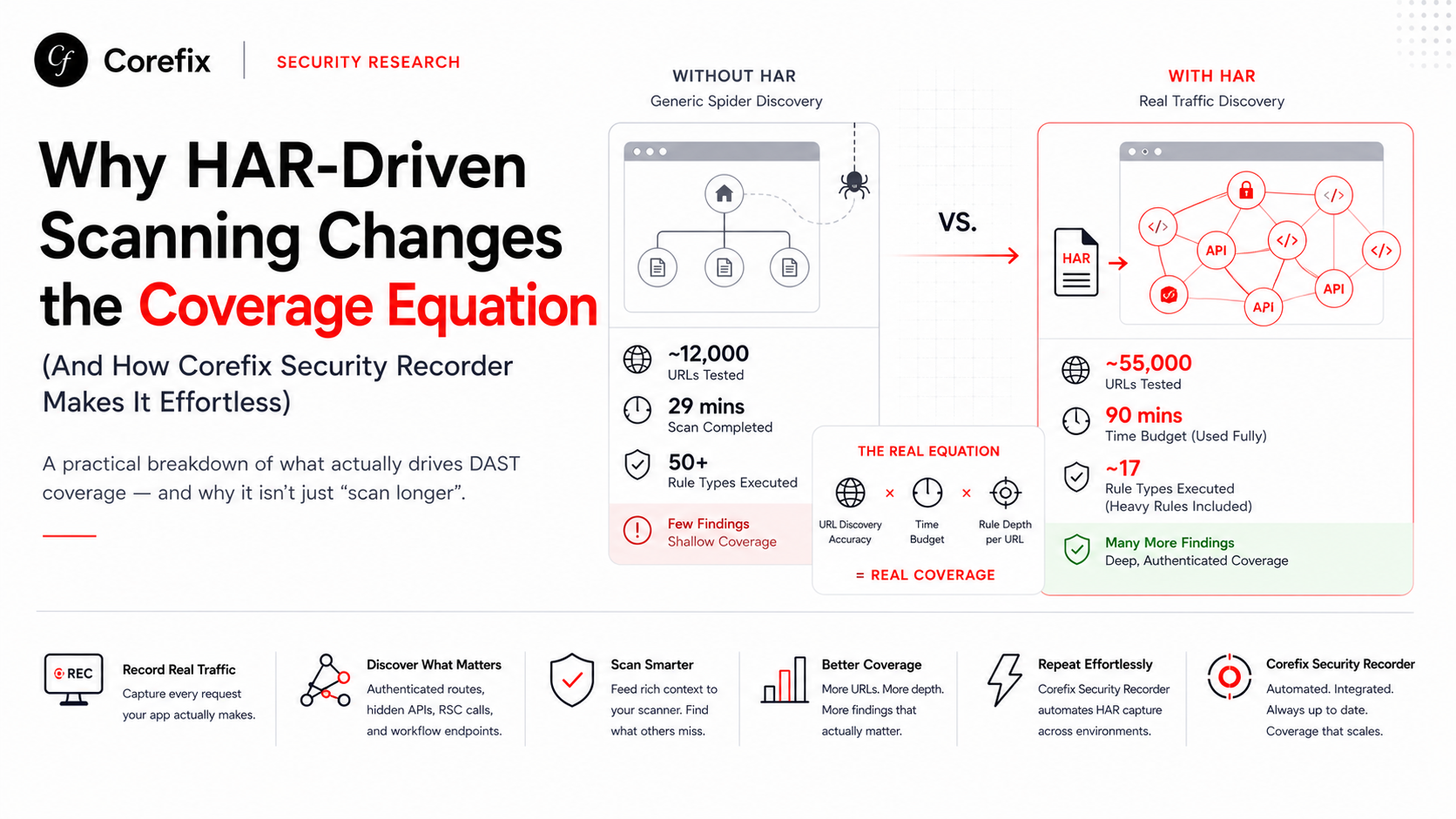

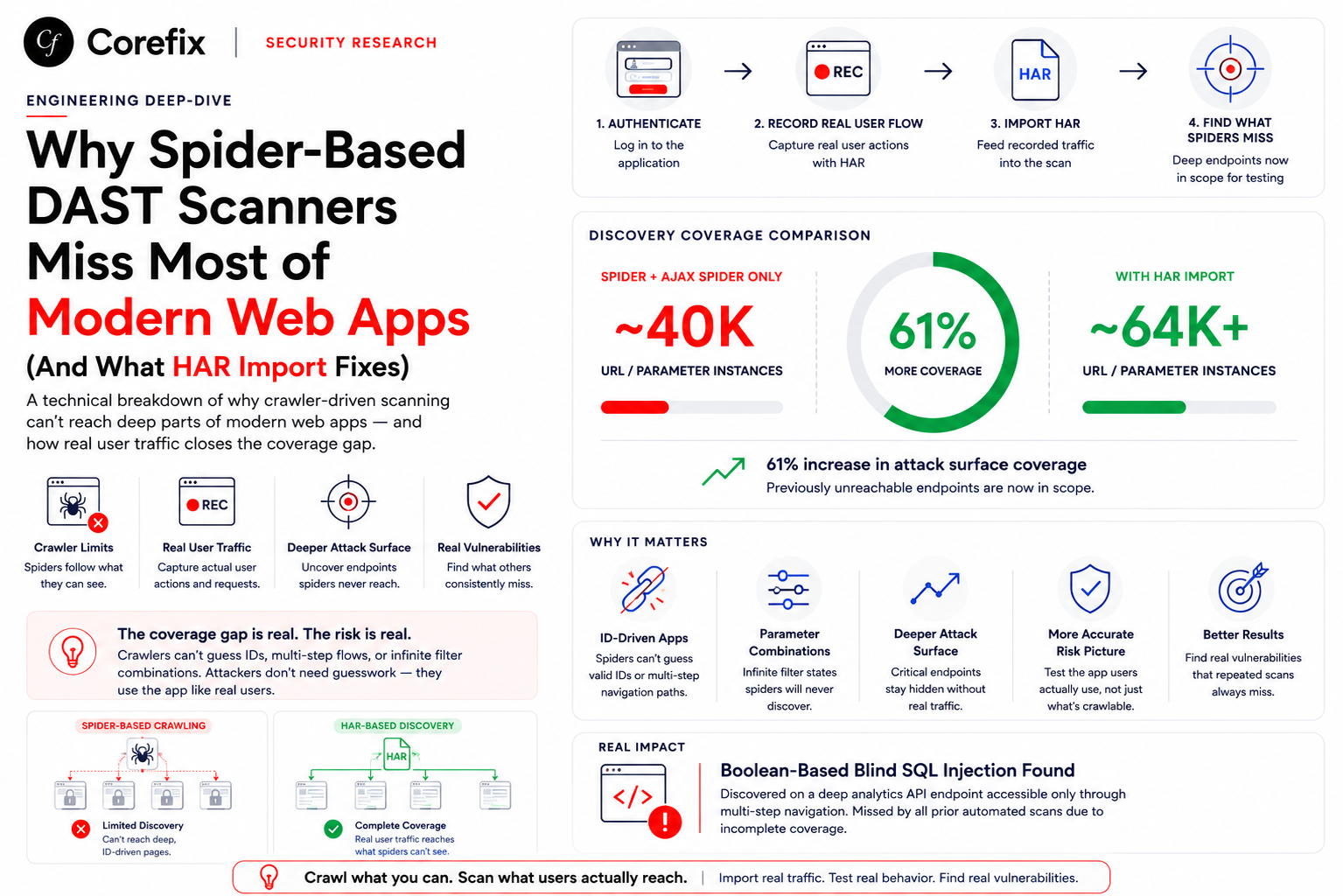

A technical breakdown of why crawler-driven scanning structurally can't reach large parts of a modern web app — and what changes when you feed a scanner real, recorded user traffic instead.
Most DAST tooling — ZAP's traditional spider, its AJAX spider, and commercial scanners like Qualys WAS and Acunetix — all share the same fundamental discovery model: point a crawler at the app and let it follow links, forms, and DOM events to find URLs. This works reasonably well for content-heavy, shallow sites. It works much worse for the kind of application most security teams actually need to test: deep, stateful, ID-driven dashboards where most of the interesting attack surface is several clicks deep behind specific user actions.
This post is about why that gap exists structurally, and what we found when we closed it using HAR-based traffic replay instead of relying on crawling alone.
The structural limitation of crawler-based discovery
A spider, no matter how sophisticated, discovers URLs by following what it can see and click — links in HTML, forms it can submit, DOM mutations an AJAX spider can trigger via headless browser interaction. This breaks down in a few predictable, common patterns:
1. Resource IDs that only exist after a prior action. Consider an endpoint like:
GET /api/units/orchid-config?unitId=45623A crawler has no way to know that unitId=45623 is a valid, meaningful ID unless it has already navigated through several prior screens — select a project, drill into a site, select a unit — each step revealing an ID the next request depends on. If any link in that chain is a button triggering a JS event rather than a plain <a href>, or if the ID is injected via a state management layer rather than present in the DOM, the crawler simply never constructs that request.
2. Multi-step dashboards with deep parameter chains. Real-world enterprise apps often have request chains like:
project → customer → site group → site → unit → device → sensor configEach level requires a specific ID from the level above. A spider exploring breadth-first (or even depth-first) has to correctly guess and execute an entire multi-step navigation sequence, in the right order, with the right IDs at each step, purely by inference from the DOM. In practice, it gets partway in and stalls — which is exactly what we saw: an AJAX spider run on its own surfaced roughly 1,300–3,300 URLs depending on the run, while a single authenticated user's actual recorded session included 370 unique URLs across 257 distinct paths that the spider variants had never touched.
3. Query-string-driven filter states. Dashboard filter panels routinely produce URLs like:
/api/monitoringdashboard/stats?fromTime=2026-07-10 00:00:00&toTime=2026-07-10 23:59:59&project=&sourceEventType=&filterToggle=falseThese parameter combinations are functionally infinite from a crawler's perspective — it has no signal for which combinations are meaningful without a human (or a script standing in for one) actually setting date ranges, toggles, and filters and observing what gets requested.
4. This isn't unique to ZAP. Commercial scanners share the identical constraint, because they use the same fundamental technique — a crawler exploring the DOM. Qualys WAS and Acunetix both offer "recorded login sequence" or "macro" features for exactly this reason: their engineering teams know pure crawling plateaus on real applications. But a recorded login macro alone still only gets you past authentication — it doesn't solve the deeper-navigation discovery problem once you're inside the app.
What HAR-based coverage does differently
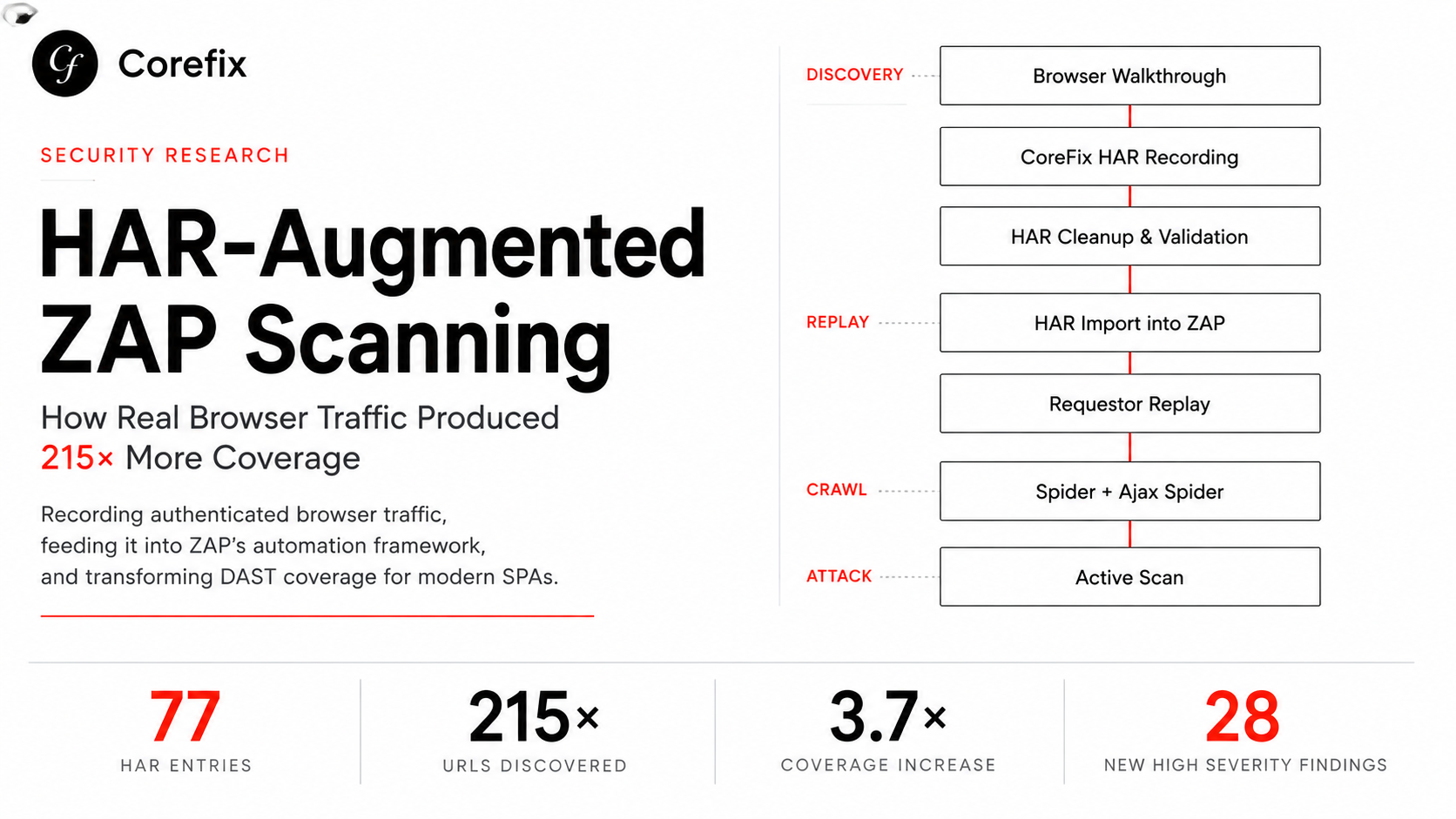
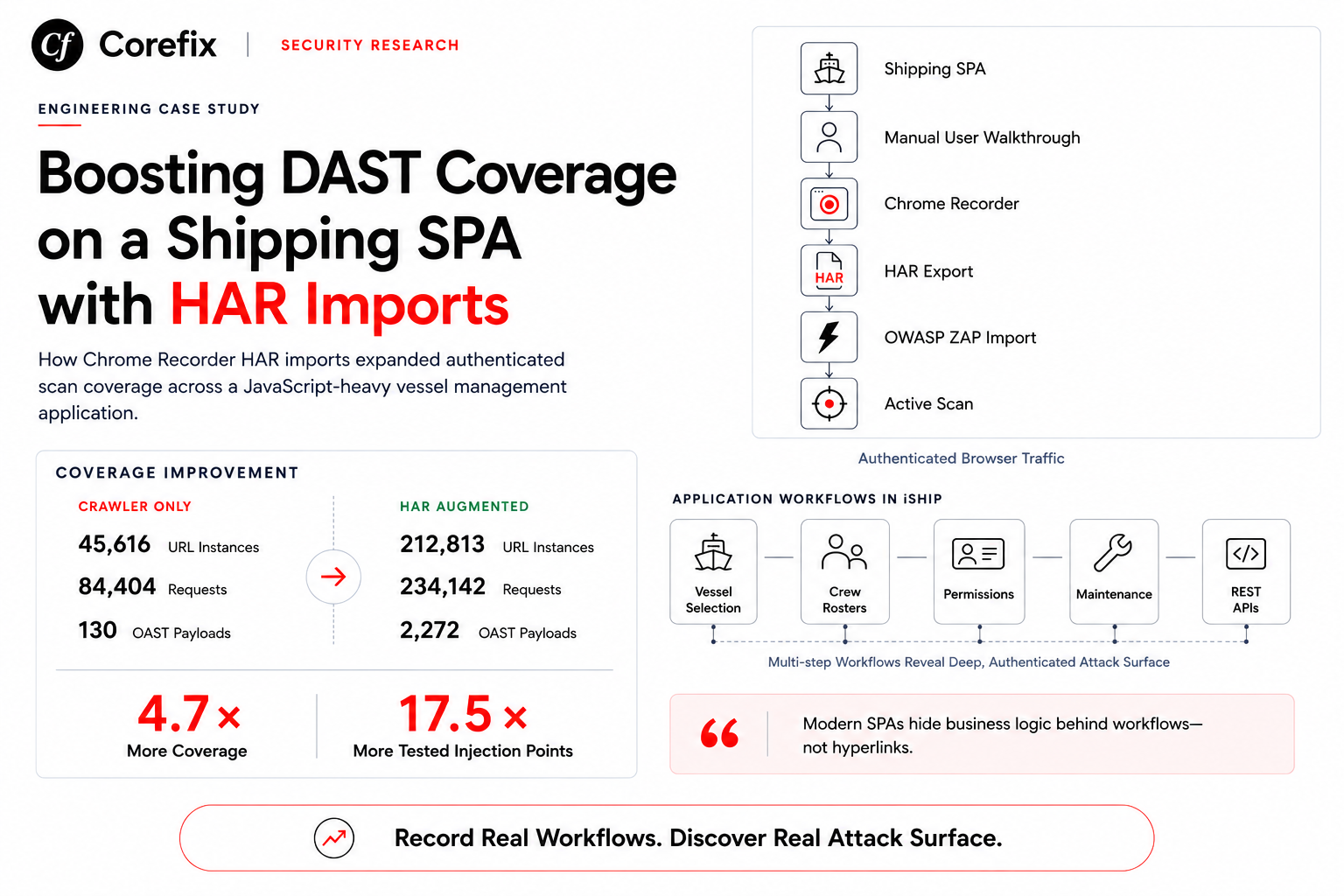
Instead of asking a crawler to infer the app's navigable structure, we record an actual authenticated user session using a Chrome extension (the Corefix HAR capture extension), covering realistic day-to-day usage — browsing projects, sites, units, dashboards, filters — and feed the resulting HAR file(s) directly into the scan as import jobs:
- name: import-har-0
  type: import
  parameters:
    type: har
    fileName: /zap/wrk/chunk_<timestamp>-clean-0.har
Every request the user actually made — with real, valid, contextually correct parameter values — gets added straight into ZAP's Sites tree, ready for passive and active scanning, with zero inference required. No guessing what unitId values are valid; the HAR file already contains a real one that the actual app accepted.
The numbers, before and after
On one recent authenticated scan of a production-style monitoring dashboard app:
| Metric | Spider + AJAX spider only | + HAR import |
|---|---|---|
| Total URL/parameter instances fed to active scan | 39,831 | 64,261 (+61%) |
| AJAX spider's own new discoveries | 1,300–3,300 (varies by run) | 583 |
That AJAX spider number dropping to 583 in the HAR-augmented run isn't a regression — it's the opposite. It means the HAR import had already pre-seeded the Sites tree so thoroughly that the AJAX spider found comparatively little left to discover on its own. The overlap between "what a real user does" and "what the app actually contains" is, unsurprisingly, close to total — because it is the app, walked by a real person instead of guessed at by a crawler.
Where it mattered concretely
The URLs uniquely contributed by HAR import were overwhelmingly the deep, ID-chained, multi-step-navigation endpoints described above:
/api/units/orchid-config?unitId=45623
/api/monitoringnotes/notesview?unit_id=45623&potentialId=95623
/api/sensorzones/dropdown?unitId=45623
/api/customersitegroups?customerId=245&projectId=574&childSiteGroupTypeId=11
/api/devices?deviceId=2391070&type=Camera
None of these are reachable without first having walked through project → customer → site group → site → unit → device in the correct sequence with the correct IDs at each hop — precisely the class of endpoint a spider structurally cannot construct on its own, and precisely where a meaningful share of an app's authenticated attack surface tends to live in practice.
The takeaway for teams relying on crawler-only DAST
If your DAST program — whether that's ZAP, Qualys WAS, Acunetix, or anything else built primarily on crawling — is only ever pointed at the app cold, with no recorded real-session input, you should assume you are testing a fraction of the app's actual authenticated surface, and specifically the shallowest fraction: the parts reachable without deep, sequential, ID-dependent navigation. The deep dashboard drill-downs, filter-driven queries, and multi-step workflows that make up the bulk of real enterprise application functionality are exactly the parts most likely to be silently skipped.
HAR-based import doesn't replace crawling — it complements it, filling in precisely the gap crawling can't close by design. In our case, doing so increased total scanned URL/parameter coverage by roughly 61%, made up almost entirely of endpoints no automated crawler variant had ever reached across multiple prior scan attempts.
Practical recommendation: if you're running authenticated DAST against any application with multi-step, ID-chained navigation — which describes most real internal tools and enterprise dashboards — record a genuine, broad user session (ideally covering as many distinct feature areas as practical) and feed it in as HAR import alongside your spider/AJAX spider jobs. Treat spider coverage as your floor, not your ceiling.