

Executive Summary
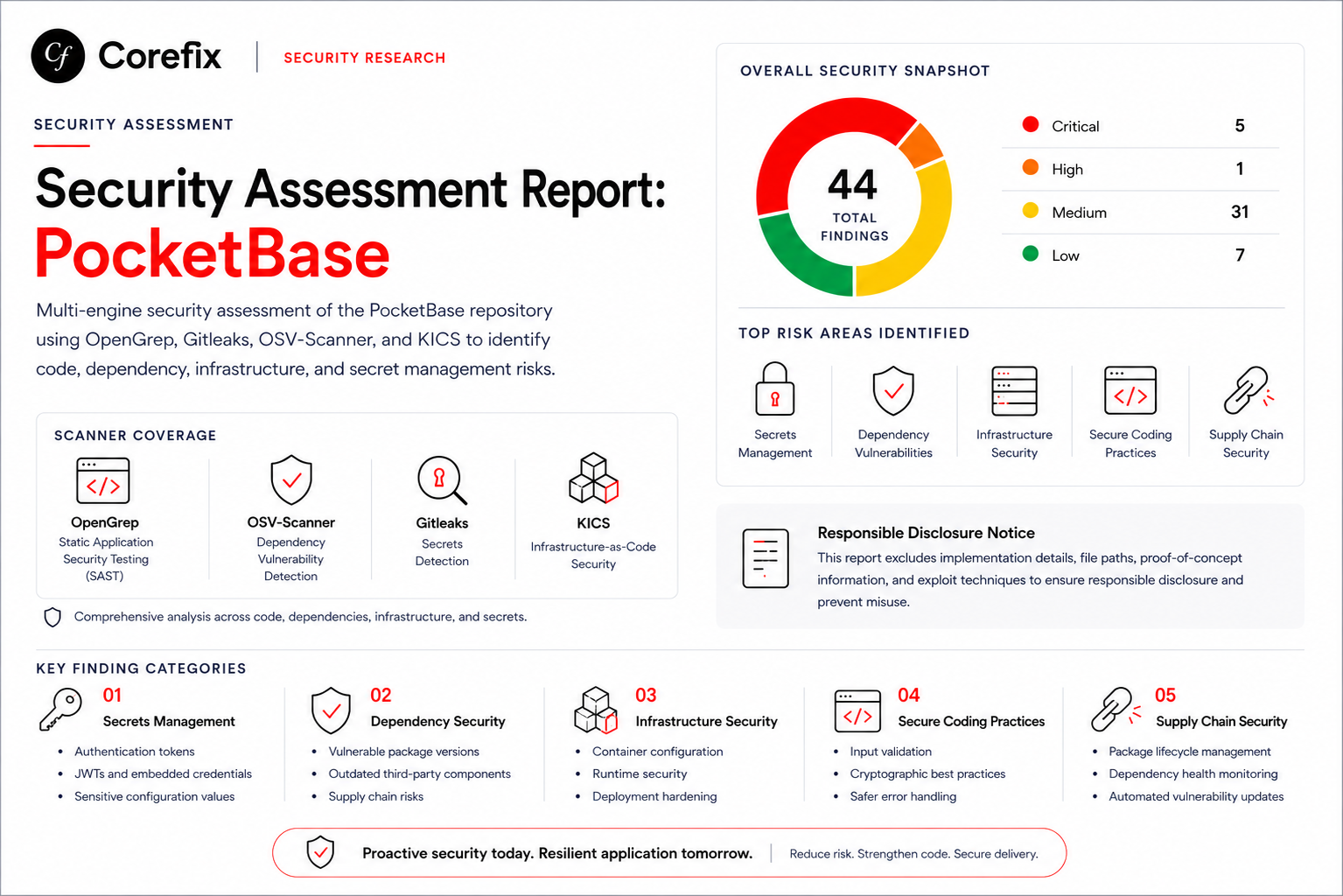
As part of our continuous application security testing (SAST) initiative, Corefix.dev performed a comprehensive security assessment of the PocketBase codebase using multiple specialized security scanners.
The objective of this assessment was to identify security weaknesses across application code, infrastructure configurations, dependencies, and secret management before they could become production risks.
Responsible Disclosure Notice
This report intentionally excludes implementation details such as source code locations, repository paths, file names, proof-of-concept information, and exploit techniques. The purpose is to improve awareness while preventing misuse.
Overall Security Snapshot
| Severity | Findings |
|---|---|
| 🔴 Critical | 5 |
| 🟠 High | 1 |
| 🟡 Medium | 31 |
| 🟢 Low | 7 |
| Total Findings | 44 |
Scanner Coverage
The repository was analyzed using multiple complementary security scanners.
| Scanner | Purpose |
|---|---|
| OpenGrep | Static Application Security Testing (SAST) |
| OSV-Scanner | Dependency Vulnerability Detection |
| Gitleaks | Secret Detection |
| KICS | Infrastructure-as-Code Security |
Using multiple specialized scanners provides broader coverage than relying on a single security tool.
Security Overview
The assessment identified findings across multiple security domains, including secure coding, dependency management, infrastructure configuration, and secrets management.
While the overall number of findings is relatively modest compared to larger enterprise applications, several high-impact issues should be prioritized because they may affect application security, deployment safety, or software supply chain integrity.
Key Findings
1. Secrets Management
The assessment detected sensitive credentials and authentication artifacts that require attention.
Observed categories include:
- Authentication tokens
- JSON Web Tokens (JWTs)
- Embedded credentials
- Sensitive configuration values
Secrets committed into repositories increase the risk of unauthorized access and should always be managed through dedicated secret-management solutions.
Recommendation
- Remove embedded secrets from source code
- Rotate exposed credentials immediately
- Store secrets using secure secret managers
- Enable automated secret scanning during CI/CD
2. Dependency Security
Third-party dependencies remain one of the most common attack vectors for modern applications.
The assessment identified:
- Vulnerable package versions
- Outdated third-party components
- Dependency upgrade opportunities
- Software supply chain risks
Maintaining secure dependencies significantly reduces exposure to publicly disclosed vulnerabilities.
Recommendation
- Continuously monitor dependencies
- Upgrade vulnerable libraries
- Automate dependency vulnerability scanning
- Maintain an accurate Software Bill of Materials (SBOM)
3. Infrastructure Security
Infrastructure configuration was also evaluated as part of the assessment.
Areas for improvement include:
- Container configuration
- Runtime security
- Infrastructure hardening
- Deployment configuration
Proper infrastructure hardening reduces the application's attack surface before deployment.
4. Secure Coding Practices
Static analysis identified several opportunities to strengthen secure coding practices throughout the application.
Common observations include:
- Input validation improvements
- Cryptographic best practices
- Secure parsing routines
- Safer error handling
- Defensive programming improvements
These recommendations improve resilience against future vulnerabilities while enhancing long-term maintainability.
5. Software Supply Chain Security
Modern applications depend heavily on third-party software.
The assessment highlighted opportunities for:
- Package lifecycle management
- Dependency health monitoring
- Automated vulnerability updates
- Continuous security verification
Supply chain security has become one of the highest priorities in modern software development.
Most Common Finding Categories
The assessment revealed recurring security themes across the repository.
Secrets Management
- Authentication tokens
- JWT exposure
- Embedded credentials
- Sensitive configuration values
Dependency Security
- Vulnerable packages
- Outdated libraries
- Supply chain improvements
- Package upgrade recommendations
Infrastructure Security
- Deployment hardening
- Container security
- Runtime configuration
- Infrastructure best practices
Secure Coding
- Input validation
- Cryptographic improvements
- Secure coding recommendations
- Defensive programming
Risk Perspective
The repository contains relatively few findings compared to larger enterprise projects, indicating a generally healthy security posture.
However, security should not be evaluated solely by the number of findings.
The most impactful issues typically involve:
- Exposed credentials
- Critical dependency vulnerabilities
- High-risk coding patterns
- Infrastructure misconfigurations
Addressing these high-priority findings first provides the greatest reduction in organizational risk.
Recommended Remediation Strategy
Phase 1 — Immediate Priority
- Remove and rotate exposed credentials
- Resolve critical dependency vulnerabilities
- Review authentication mechanisms
- Address high-severity findings
Phase 2 — High Priority
- Upgrade vulnerable dependencies
- Improve infrastructure hardening
- Strengthen runtime security
- Review deployment configurations
Phase 3 — Medium Priority
- Improve secure coding practices
- Enhance validation logic
- Standardize security configurations
- Improve automated testing coverage
Phase 4 — Continuous Security
- Integrate automated SAST into CI/CD
- Continuously monitor dependencies
- Perform periodic infrastructure reviews
- Conduct recurring security assessments
- Enforce secure development policies across repositories
Why Multi-Scanner Security Analysis Matters
Modern applications face risks from multiple sources beyond application code.
Using specialized security tools enables organizations to detect:
- Source code vulnerabilities
- Dependency vulnerabilities
- Embedded secrets
- Infrastructure misconfigurations
- Software supply chain risks
A layered security assessment provides significantly better visibility than relying on any single security scanner.
Responsible Disclosure
This assessment intentionally omits:
- Source code locations
- Repository paths
- File names
- Line numbers
- Exploitation techniques
- Proof-of-concept examples
- Sensitive implementation details
The objective is to promote secure software engineering while following responsible disclosure principles.
Final Thoughts
The PocketBase assessment demonstrates that even mature, lightweight backend frameworks benefit from continuous security validation. While the repository exhibits a relatively small number of findings, the presence of critical issues — including secret management and dependency-related risks — highlights the importance of integrating security throughout the software development lifecycle.
Security is not achieved through one-time reviews but through continuous monitoring, automated scanning, and systematic remediation. By incorporating multi-engine security analysis into development workflows, engineering teams can identify issues early, reduce remediation costs, and maintain a stronger security posture over time.
Scanned with Corefix.dev
Automated multi-engine security analysis for modern software repositories.