

Executive Summary
As part of our continuous application security testing (SAST) initiative, Corefix.dev performed an automated security assessment of the LangChain codebase using multiple industry-standard security scanners.
The objective of this assessment was to identify security weaknesses, insecure configurations, exposed secrets, and secure coding issues before they can become exploitable in production.
Important Note
This report intentionally omits implementation details, source code locations, file paths, and proof-of-concept information to ensure responsible disclosure and prevent misuse.
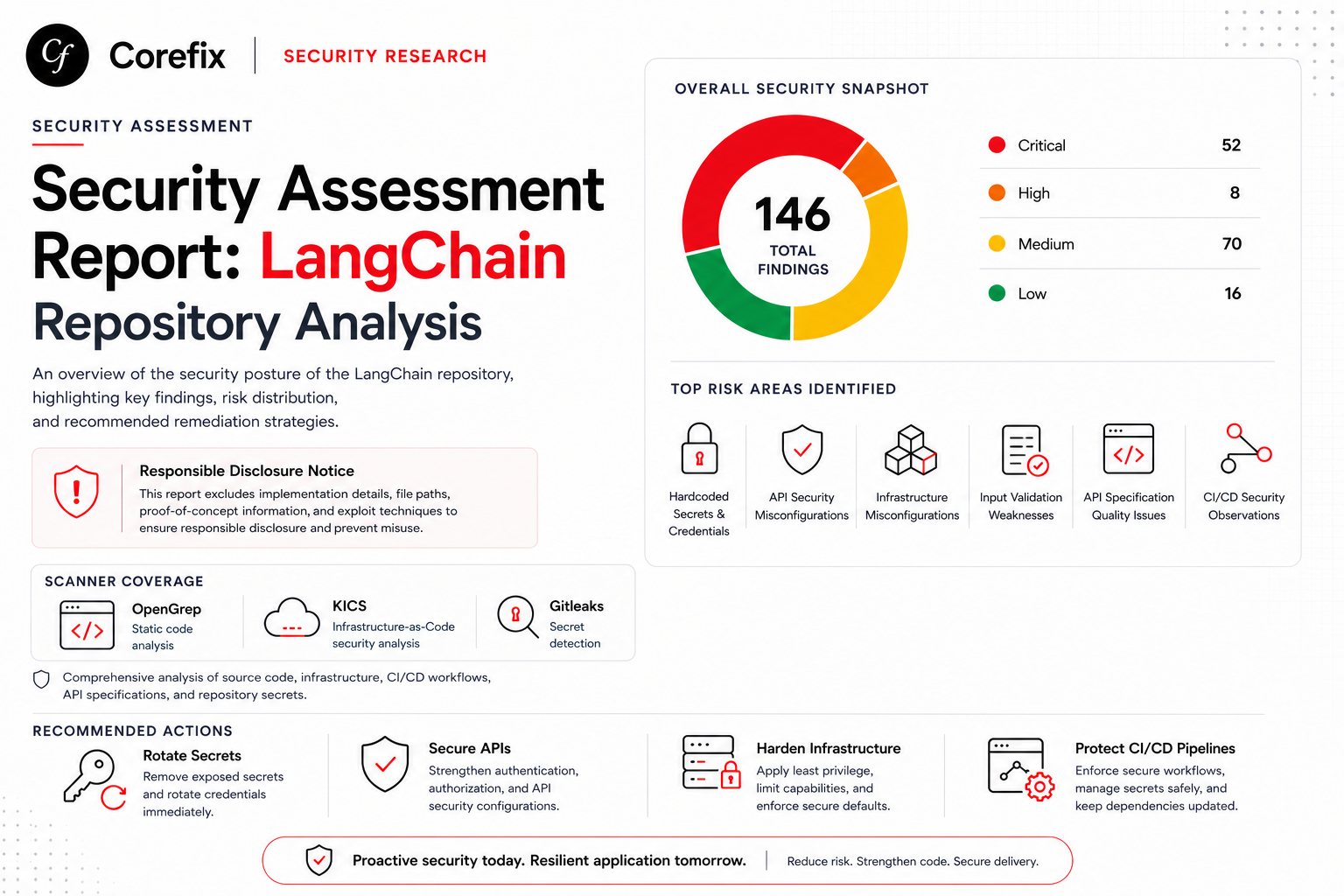
Overall Security Snapshot
| Severity | Findings |
|---|---|
| 🔴 Critical | 52 |
| 🟠 High | 8 |
| 🟡 Medium | 70 |
| 🟢 Low | 16 |
| Total Findings | 146 |
Scanner Coverage
The assessment combined results from multiple specialized security scanners:
- OpenGrep — Static code analysis
- KICS — Infrastructure-as-Code security analysis
- Gitleaks — Secret detection
Together these tools analyzed source code, infrastructure configuration, CI/CD workflows, API specifications, and repository secrets to provide a comprehensive security review.
Key Findings
Although many findings represent secure coding improvements rather than immediately exploitable vulnerabilities, several recurring security patterns deserve attention.
1. Hardcoded Secrets and Credentials
One of the most critical categories detected involves hardcoded secrets and sensitive credentials.
Potential exposures include:
- API keys
- Generic passwords
- Private keys
- Authentication secrets
Hardcoded credentials are among the most common causes of unauthorized access because they may eventually become exposed through version control, logs, or accidental disclosure.
Recommendation
- Store secrets in dedicated secret managers
- Rotate exposed credentials
- Remove sensitive information from source code
- Use environment variables or vault solutions
2. API Security Configuration Issues
The scan identified multiple API specification security weaknesses.
Examples include:
- Missing global security definitions
- Undefined authentication configuration
- Missing security schemes
- Incomplete authorization configuration
- HTTP usage instead of secure transport definitions
Poor API security configuration increases the likelihood of authentication bypass, insecure deployments, and inconsistent access control across services.
3. Infrastructure Security Misconfigurations
Several Infrastructure-as-Code (IaC) security issues were detected.
Common examples include:
- Containers without resource limits
- Missing security options
- Excessive container capabilities
- Missing health checks
- Network configuration weaknesses
These issues may not immediately result in compromise but can significantly increase the attack surface of deployed workloads.
4. Input Validation Weaknesses
The assessment found multiple schema validation and specification issues, including:
- Missing maximum lengths
- Missing minimum values
- Undefined validation patterns
- Missing required properties
- Numeric constraints not enforced
- Incomplete schema definitions
Weak input validation often leads to unexpected application behavior and increases the likelihood of future security vulnerabilities.
5. API Specification Quality Issues
The repository contains several OpenAPI specification inconsistencies, including:
- Missing response definitions
- Undefined schemas
- Invalid schema formats
- Ambiguous paths
- Missing path parameters
- Unknown properties
While these issues are primarily specification quality concerns, they can negatively impact API security, client generation, and long-term maintainability.
6. CI/CD Security Observations
The scan also reviewed GitHub Actions workflows and identified opportunities to strengthen pipeline security.
Examples include:
- Workflow permission improvements
- Secret inheritance considerations
- Dependency update configuration improvements
- GitHub Actions security best practices
Securing CI/CD pipelines is increasingly important because attackers frequently target build systems as an initial entry point.
7. Secure Coding Improvements
Several secure coding recommendations were identified throughout the codebase, including:
- Safer XML parsing
- Avoiding insecure hash algorithms
- Safer dynamic imports
- Safer regular expression handling
These findings generally represent defense-in-depth improvements that help reduce future security risk.
Most Common Finding Categories
The assessment identified recurring patterns across the repository.
Secrets Management
- Hardcoded secrets
- Private keys
- Generic passwords
- API credentials
API Security
- Missing security definitions
- Authentication configuration issues
- API specification inconsistencies
- Schema validation gaps
Infrastructure Security
- Container hardening
- Resource management
- Runtime security configuration
- Network configuration
Secure Coding
- Dynamic import risks
- XML parsing
- Cryptographic improvements
- Regular expression safety
CI/CD Security
- GitHub Actions security
- Dependency management
- Pipeline hardening
- Automation configuration
Risk Perspective
Not every finding represents an immediately exploitable vulnerability.
The scan includes a combination of:
- High-impact security issues
- Secure coding recommendations
- Infrastructure hardening opportunities
- API specification improvements
- Security best-practice violations
Addressing higher-severity findings first provides the greatest reduction in overall organizational risk while improving the long-term security posture of the project.
Recommended Remediation Strategy
A practical remediation roadmap is outlined below.
Phase 1 — Immediate Priority
- Remove exposed secrets and credentials
- Rotate compromised credentials
- Review authentication configuration
- Address critical infrastructure issues
Phase 2 — High Priority
- Strengthen API security definitions
- Harden container configurations
- Improve CI/CD workflow security
- Review dependency management policies
Phase 3 — Medium Priority
- Improve schema validation
- Strengthen input validation
- Review API specifications
- Improve configuration consistency
Phase 4 — Continuous Improvement
- Enforce secure coding standards
- Integrate automated security scanning into CI/CD
- Continuously monitor dependencies
- Perform periodic security reviews
Why Continuous Security Scanning Matters
Modern software evolves rapidly.
New code, updated dependencies, infrastructure changes, and CI/CD modifications can introduce security risks at any stage of development.
Continuous security scanning enables teams to:
- Detect issues earlier in the development lifecycle
- Reduce remediation costs
- Improve developer productivity
- Maintain compliance
- Strengthen overall software resilience
Responsible Disclosure
This article intentionally excludes:
- Source code locations
- File names
- Line numbers
- Repository paths
- Exploitation techniques
- Proof-of-concept examples
- Sensitive implementation details
The goal is to educate development teams about common security risks while following responsible disclosure practices.
Final Thoughts
The LangChain assessment demonstrates how modern repositories can accumulate security findings across source code, infrastructure, API specifications, secrets management, and CI/CD workflows.
While the presence of findings does not necessarily indicate active exploitation, proactive remediation significantly reduces future risk and improves the project's overall security maturity.
Security should be treated as an ongoing engineering practice rather than a one-time activity. Integrating automated security analysis into every stage of the software development lifecycle helps organizations build resilient and trustworthy software.
Scanned with Corefix.dev
Automated multi-engine security analysis for modern software repositories.